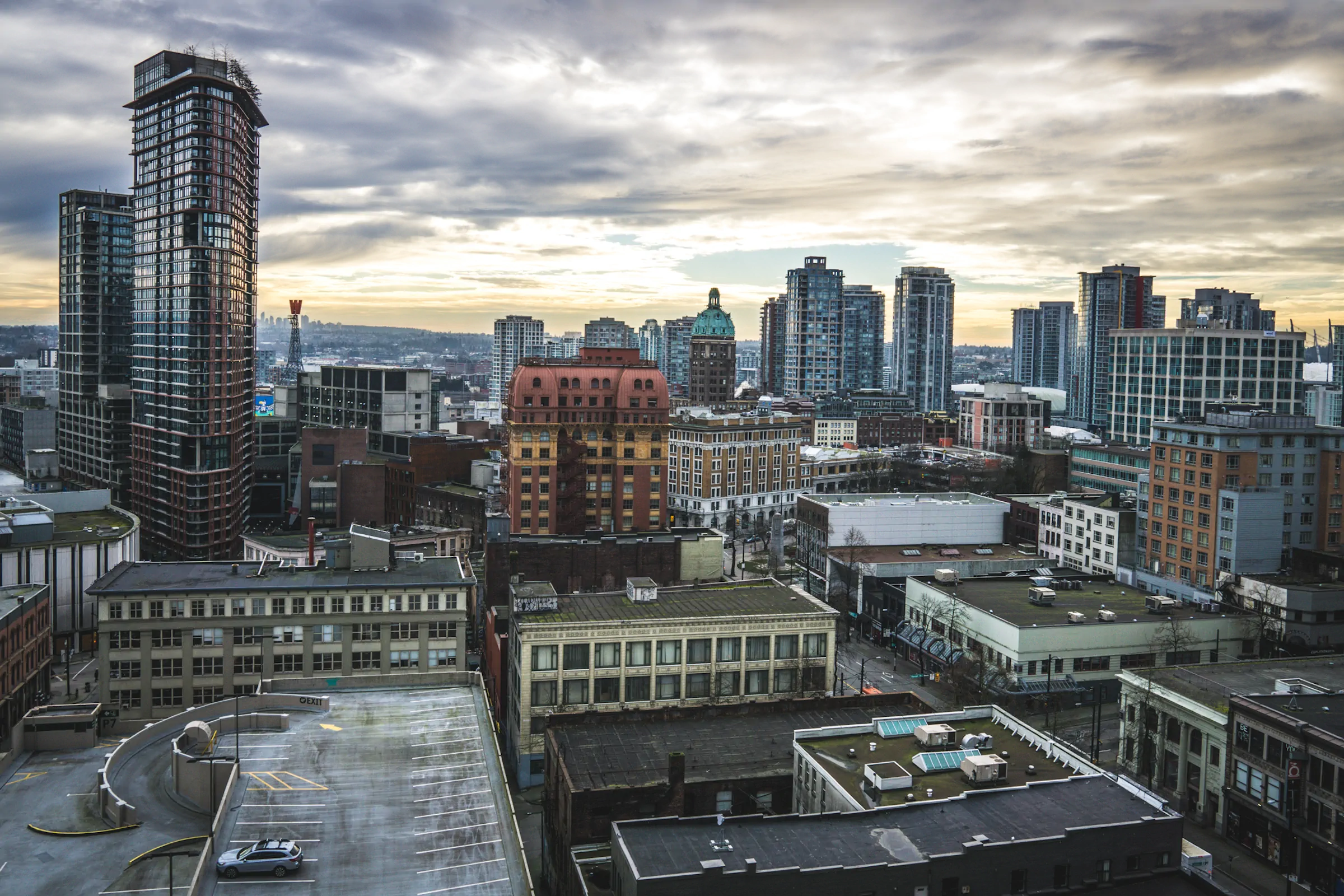
Dominion Building, Sun Tower and Woodward's from Harbour Centre
Looking east from Harbour Centre across Victory Square and the Downtown Eastside, the Dominion Building, Sun Tower and Woodward's W pick out three generations of Vancouver's eastern downtown skyline. Before the office towers marched west toward Burrard Street, this was where Vancouver was busy proving that it had become a serious city.
The Dominion Building was one of the more expensive proofs. Completed in 1910 at Hastings and Cambie, the steel-framed office tower was promoted to local investors as something that would advertise Vancouver's prosperity to the world. Imperial Trust, which started the project, could not raise enough money to finish it. Dominion Trust took over, and the building opened anyway.
The timing was not excellent.
Its unusual central-core plan sacrificed rentable office space, tenants were slower to arrive than hoped, and the courthouse across the street, one of the reasons lawyers and financial firms congregated around what is now Victory Square, moved to Georgia Street in 1913. A year later Dominion Trust collapsed spectacularly. Contemporary financial reporting found the situation stranger still: the federally chartered company had continued taking deposits even though its charter did not actually give it banking powers.
Two years after the Dominion Building opened, the World Building rose a few blocks away.
Today it is the Sun Tower, but in 1912 it was newspaper publisher and politician L.D. Taylor's attempt to put the Vancouver World into a building impossible to ignore. Shares in the building company were advertised while the tower was under construction. Its eventual cost climbed well beyond the original estimate, and postcards proudly promoted it as the tallest building in the British Empire.
Even that boast is worth treating carefully. Contemporary professional reporting appears to have been less enthusiastic, calling it the tallest building in Vancouver rather than settling the entire Empire question.
The finances were no less shaky than the bragging rights. By 1915 Taylor had lost control of the World and the building. Years later, an early Vancouver resident remembered the location as a mistake and reduced the whole adventure to the essentials: too much building, not enough location, mortgages at the end.
The commercial centre kept moving west.
Woodward's went the other way. Its department store made West Hastings a destination for generations, disappeared in 1993, then returned in radically different form after the enormous redevelopment completed in 2009. The red W visible here is itself a successor: the original rooftop sign was too deteriorated to reinstall and survives down in the development's courtyard.
From Harbour Centre, the sequence is unusually tidy. Two skyscrapers from a speculative boom that went wrong. A department-store landmark rebuilt after another kind of collapse. Towers behind them, towers beside them, and the city's centre of gravity somewhere farther west.
Join the conversation