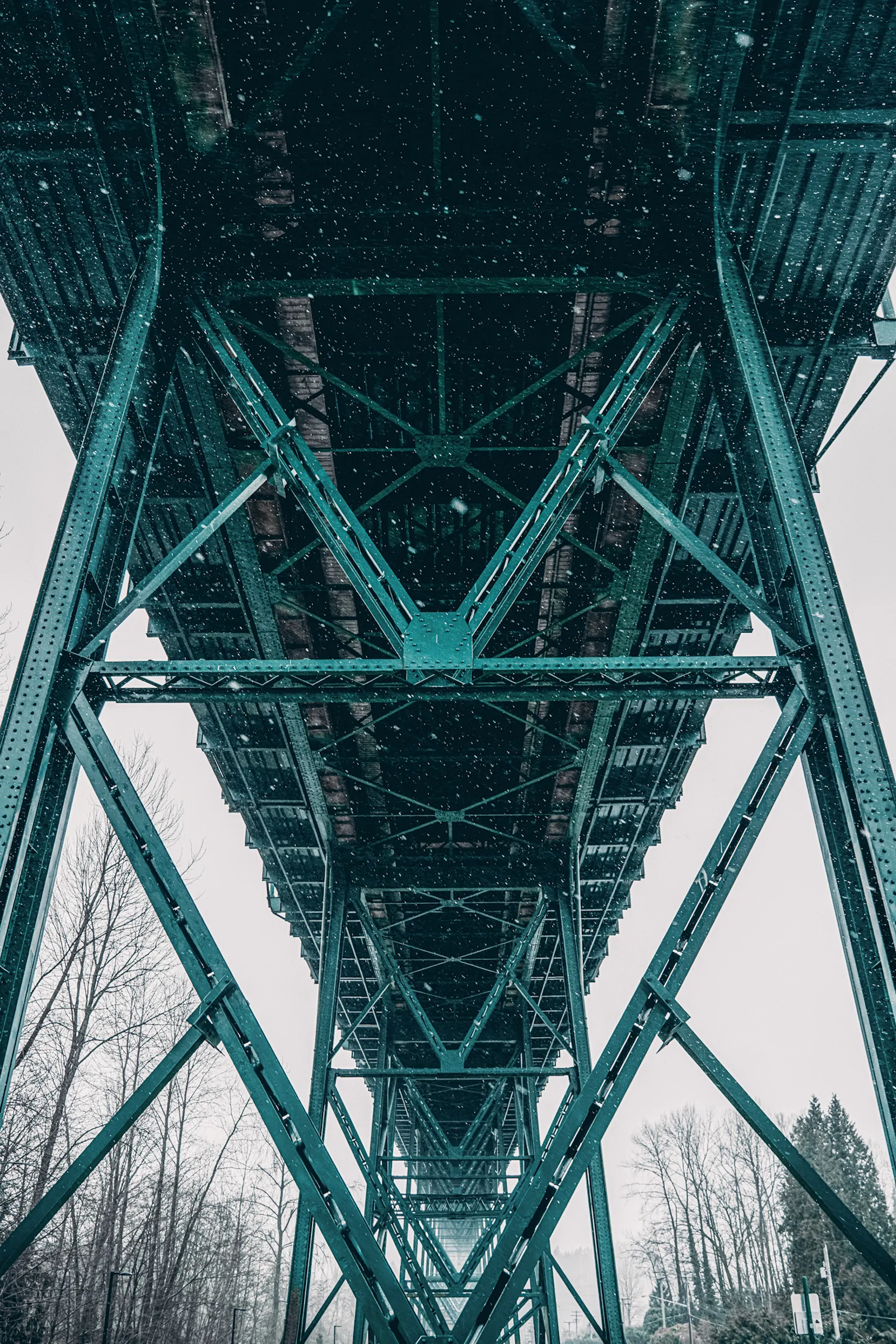
Under the Lions Gate Bridge, North Shore
Under the north approach of Vancouver's Lions Gate Bridge, the structure develops a date problem. Much of the riveted support steel belongs to 1938. The roadway immediately above it was rebuilt in 1975.
That distinction is easy to miss from down here. Everything has been painted the same deep green, and the old plate girders, braces, gussets and newer deck read as one elaborate machine. Snow drifting through the open steelwork makes the joints easier to notice. There are a great many of them.
The north side posed a basic geographical problem for the original engineers. Stanley Park gave the bridge a high bluff at one end. The North Shore did not. To reach suspension-bridge height from the Capilano floodplain, they built a sloping steel viaduct more than 600 metres long. Dominion Bridge supplied and erected the steel. By the time the bridge opened in 1938, the official souvenir booklet could inventory 10,200 tons of steel and 360 tons of rivets, bolts and form rods across the whole project.
The rivets are worth looking at because they later became part of a very different engineering problem.
By the early 1970s, the north viaduct was wearing out badly. The original roadway was a seven-inch reinforced-concrete slab with no proper wearing surface. Water drained onto the steel below. Road salt and studded tires accelerated the damage. Engineer Peter Taylor's 1978 account is refreshingly free of heritage sentiment: the deck was "essentially failed." Even the support steel had suffered. Rust forming beneath thin cover plates had expanded enough to buckle some of them by about half an inch between rivets.
Demolishing the viaduct and starting again would have been straightforward compared with what came next. Vancouver already depended on the bridge. Peak traffic needed all three lanes, and the engineers were given roughly six hours at night to remove part of the roadway and leave something driveable in its place by morning.
Their solution kept much of the old supporting steel and replaced the heavy concrete road with a lighter steel orthotropic deck. Fifty-eight prefabricated sections were installed during overnight closures. Before the changeover, crews removed the old floor-beam rivets and replaced them with high-strength bolts so sections could come apart quickly when the clock was running. The new crossbeams were then fitted back onto the existing girders. Oversized steel shims absorbed the inevitable mismatch between a factory-made 1975 component and a bridge that had spent nearly forty years outside. Countersunk bolts went through existing rivet holes.
It is difficult to stand underneath this and maintain the idea that an old bridge has a single age.
Some of the steel above has been carrying loads since cars first crossed here before the Second World War. Other parts arrived during a rehabilitation that became an engineering achievement in its own right. The suspended portion farther toward Stanley Park went through another extraordinary replacement around 2001, when the entire structure hanging from the main cables was renewed section by section while the bridge kept reopening to traffic.
The craftsmanship in this photograph is therefore spread across decades. There was no single heroic moment when the Lions Gate Bridge was completed. Men riveted it together, other crews came back to cut parts loose, engineers figured out how much old steel could stay, painters sealed it again, and inspectors kept returning.
Join the conversation