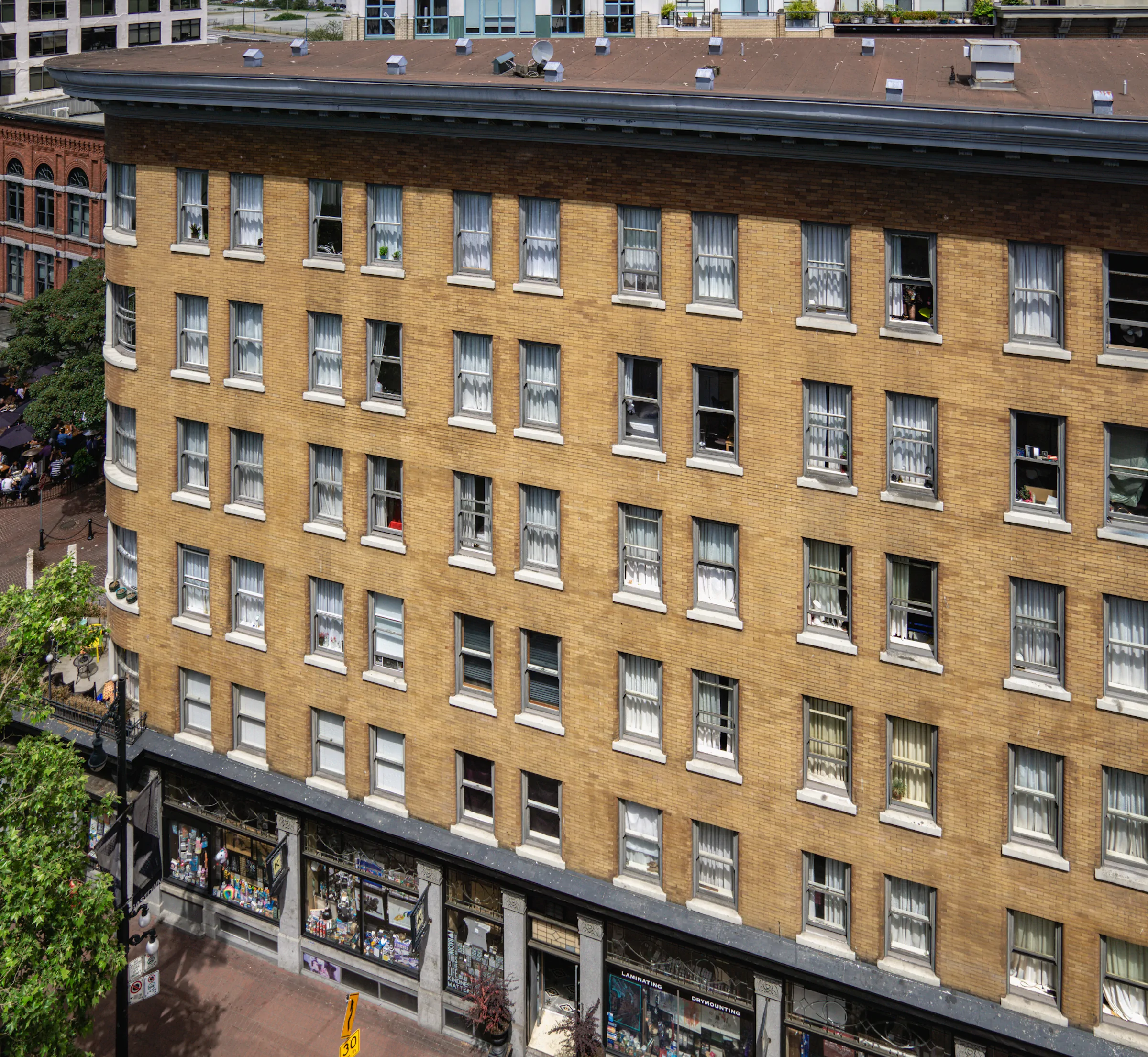
Hotel Europe South Facade, 43 Powell Street, Vancouver
Hotel Europe at 43 Powell Street in Gastown was built in 1908-09 for Italian immigrant hotelier Angelo Calori, with Parr and Fee fitting a reinforced-concrete hotel onto the triangular block where Powell and Alexander streets split. The pointed end at Maple Tree Square made it one of Vancouver's standard postcard buildings. This south facade is more ordinary, and more useful for understanding what happened to the place: six storeys of rooms behind rows of windows.
Calori's hotel business went back almost to Vancouver's beginning. After the fire of 1886 he acquired a surviving wooden building and turned it into the European Hotel, later renamed the Hotel Europe. By the time he was ready for a major expansion, he had become one of the relatively few prosperous Italian businessmen in a city where Italian immigrants were still largely treated as cheap manual labour. In 1905 he also helped found the Sons of Italy mutual-benefit society, created partly because immigrant workers who fell sick, died or lost work often had very little institutional support.
That same year Calori bought five fractional lots at Powell and Alexander. A contemporary report described the property with the wonderfully blunt real-estate term "the gore." His first announced plan was for a four-storey tourist hotel with elevators and modern equipment. What appeared a few years later was considerably more ambitious.
Parr and Fee designed a six-storey building around a reinforced-concrete frame erected by the Ferro-Concrete Construction Company of Cincinnati. The company had built the sixteen-storey Ingalls Building in 1902, an early landmark in concrete construction. Vancouver's heritage register is careful about the claim sometimes made for Hotel Europe: it calls the frame the first of its kind in Vancouver and says the building was purportedly the earliest fireproof hotel in Western Canada. That is rather safer than the frequently repeated claim that it was Canada's first reinforced-concrete building.
Calori had judged the technology well. He was less fortunate with Vancouver's geography.
A federal housing history published in 1984 records that he expected this end of town to remain Vancouver's commercial centre and imagined the new Europe attracting the best travelling clientele. By the time the hotel opened, business was already drifting west toward Granville Street. The Europe found its market among working travellers instead. The Calori family kept it until 1949 and maintained a respectable hotel known for a "good table." The clientele changed, but the rooms kept earning their keep.
By the late 1970s the situation was much rougher. Renovation schemes went nowhere, fire and health deficiencies accumulated, and in 1982 the City revoked the hotel's operating licence. The remaining tenants had to leave.
The rescue was unusually literal. The Affordable Housing Association of Vancouver bought the building and rebuilt it as low-cost housing. CMHC insured a $3.1-million mortgage, provided a $287,750 rehabilitation grant and supplied an annual subsidy intended to keep rents down. The restored Europe reopened on November 30, 1983.
The 1984 CMHC account gives a better picture of the new building than any heritage plaque. There were 33 self-contained bachelor and one-bedroom apartments and 50 housekeeping units with shared washrooms. Those smaller rooms still had their own refrigerator, sink and two-burner stove. Central City Mission managed the property. The people moving in ranged from 19 to 89 years old: students, seniors, seasonal workers, unemployed residents and people with jobs nearby.
Later City records list 84 non-market units at Hotel Europe. The building celebrated for its razor-thin corner has therefore spent the last four decades doing something much less photogenic and considerably more useful.
Soon after the 1983 reopening, assistant manager Steve Garrett described the reaction of the new residents to CMHC: "to them, it's a palace."
Join the conversation