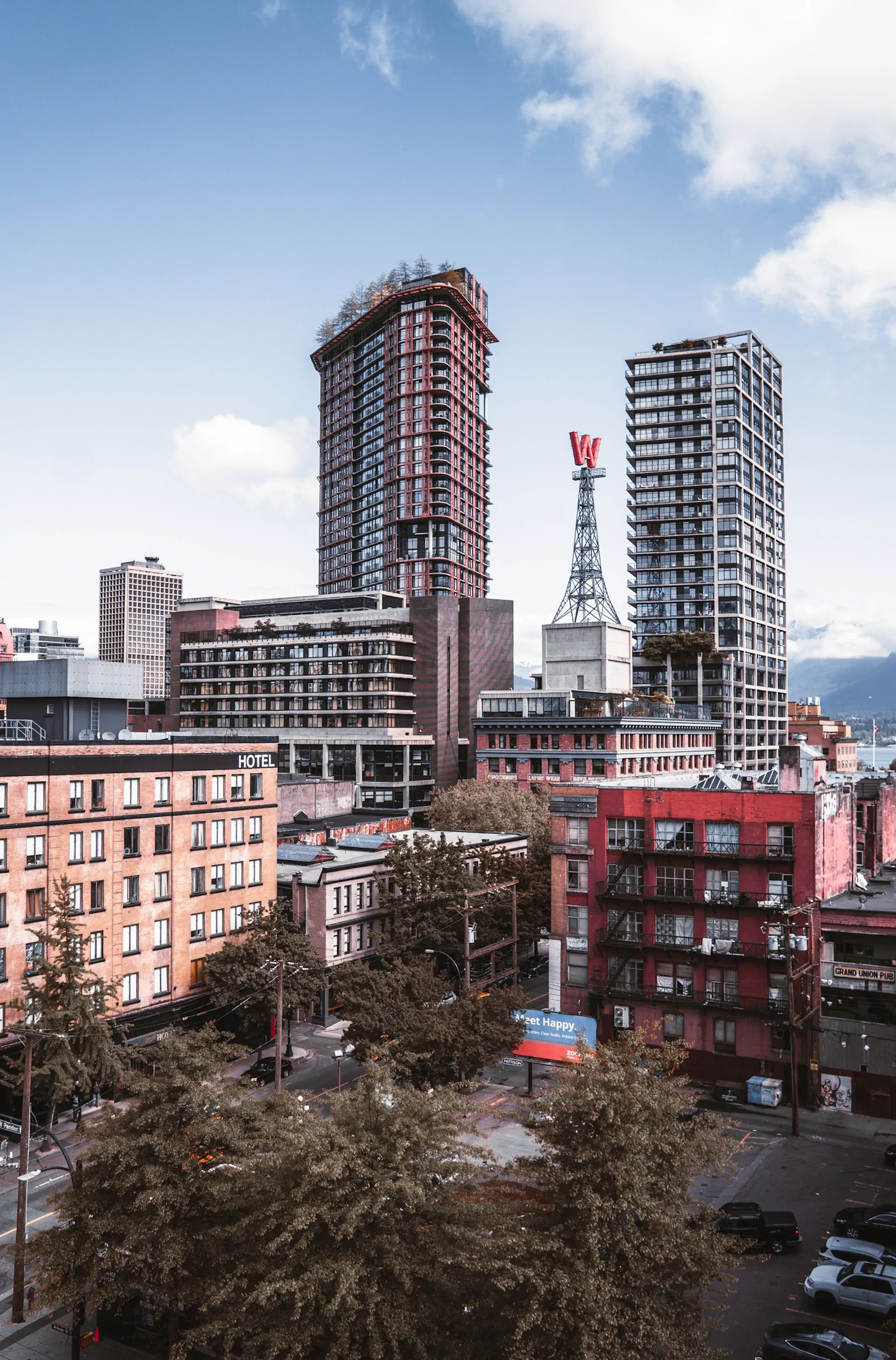
Woodward's and the Old Hotels Around Abbott Street, Vancouver
Looking north from West Pender and Abbott, the Woodward's "W" rises above a cluster of old downtown hotels, including the Lotus Hotel at 455 Abbott Street and the Grand Union on West Hastings. It is a useful little cross-section of a part of Vancouver that has spent more than a century changing the names on its doors without quite settling the argument over who gets to live here.
The building at the left edge of the photograph was still the Lotus Hotel when this picture was made. It had opened in 1913 with rather grander intentions. Designed by Arthur J. Bird, the six-storey hotel contained 120 rooms and advertised itself as fireproof, soundproof and even vermin-proof. The bar was sixty feet of mahogany. There were bronze chandeliers, stained glass, private bathrooms and enough structural capacity for another two storeys if prosperity demanded them.
Prosperity proved unreliable.
By the middle of the century, the Lotus was better known to police than travel agents, with gambling, illegal liquor and the occasional shooting turning up in newspaper reports. Then the building acquired another life. From the 1980s onward it became an important part of Vancouver's queer nightlife. AIDS Vancouver held early meetings there. By the 1990s several queer bars operated inside, and from 2003 to 2011 the small Lick nightclub became a particularly important space for lesbian, trans and queer communities.
Up on Hastings, the Grand Union managed an even better trick: the hotel moved without moving the building.
The original Grand Union occupied another address farther east on the same block. When that property was demolished in 1916 for the new Pantages Theatre, proprietor Isbrand DeFehr transferred the Grand Union name and hotel licence to Bergman's Rooms and Café at 74 West Hastings. The old café became the beer parlour. The borrowed name stayed.
Behind both of them is Woodward's, which had already performed its own much larger act of disappearance and return. The department store closed in 1993. After years of failed redevelopment schemes, the 2002 Woodsquat and a City purchase the following year, most of the sprawling old complex was demolished and replaced by the present mixed-use development.
The social geography was unusually explicit. Market housing was concentrated toward Cordova and Gastown. Non-market housing for single residents faced Hastings and the Downtown Eastside. The restored 1903 portion held non-profit uses. The project was promoted as an attempt to mix incomes and uses rather than simply push one neighbourhood out with another.
From this parking lot, those ambitions stack up neatly.
A luxury hotel turned SRO turned queer nightclub turned student housing. A hotel name that migrated down the block. Old cheap rooms in front of market towers and non-market housing beneath the same enormous red "W".
The names change faster than the argument.
Join the conversation