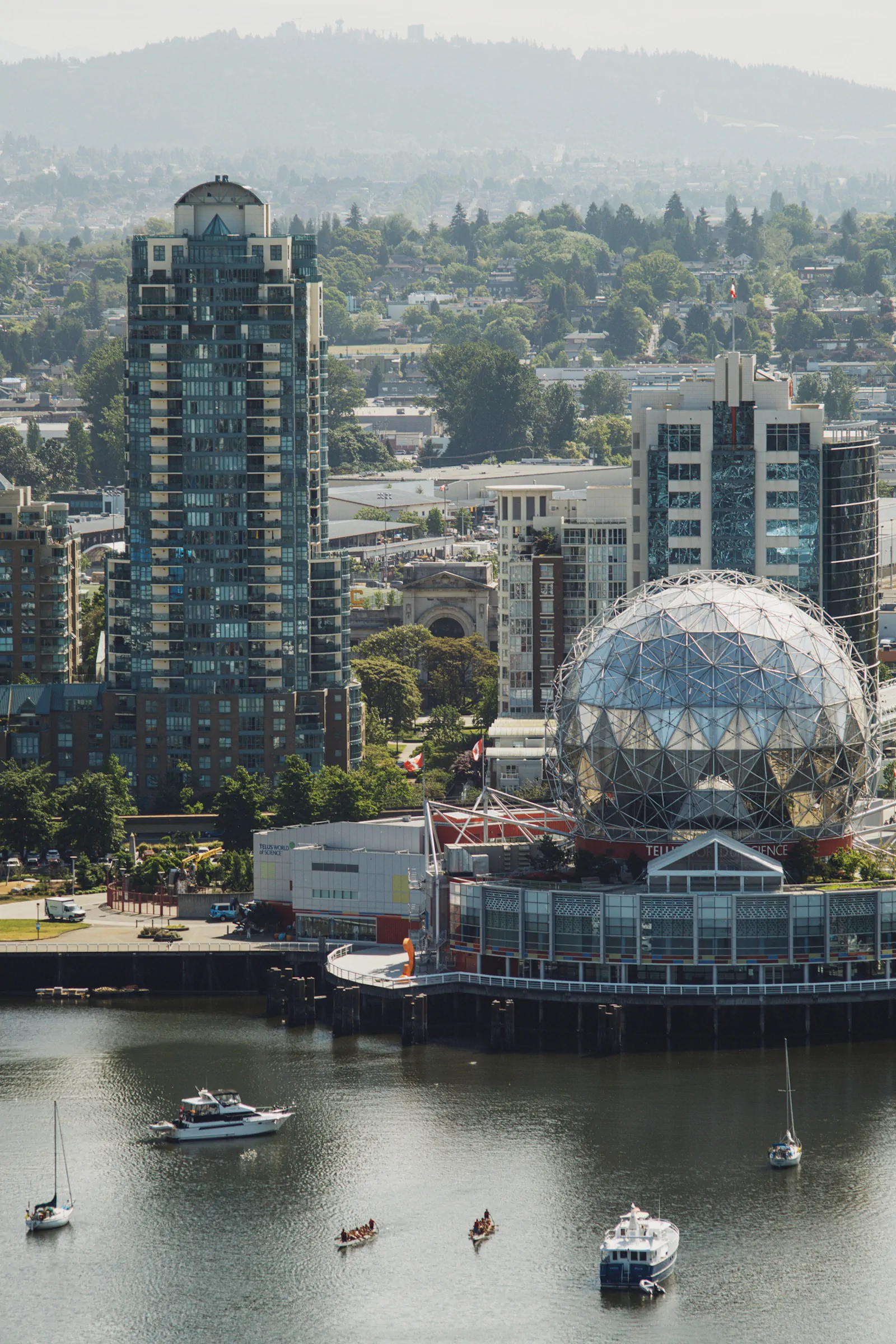
Science World with Pacific Central Station, Vancouver
Science World at 1455 Quebec Street sits at the eastern end of False Creek, with the monumental entrance arch of Pacific Central Station visible in the narrow gap behind it. The two buildings were conceived as gateways to Vancouver, sixty-seven years apart: one for passengers arriving on a transcontinental railway, the other for visitors entering Expo 86.
The railway station's arch was meant to say exactly that. A 1920 description in the trade journal Construction called it "a gateway to the city." Pratt & Ross gave the entrance a 52-foot-high arch, a three-storey ornamental iron window and a keystone weighing about thirty tons. It was a fairly serious welcome.
The company that commissioned it never got to enjoy the effect. Canadian Northern began the station on reclaimed land in False Creek, ran into financial collapse, and disappeared amid the railway consolidation that produced Canadian National. When the terminal finally opened in November 1919, the name over the business had changed. For several decades another grand station stood immediately beside it, serving the Great Northern Railway. That one came down in 1965. The Canadian Northern building survived and eventually became known as Pacific Central Station.
Then Vancouver built another entrance nearby.
Bruno Freschi placed the Expo Centre at the eastern end of the 1986 World's Fair, where it announced the beginning of a 4.5-kilometre exposition devoted, appropriately enough, to transportation and communication. The building opened a year early as the Expo Preview Centre. Its dome contained 766 aluminum triangles wrapped around a steel structure and an OMNIMAX theatre.
Freschi's early drawings were considerably stranger.
The City of Vancouver Archives has recently opened his Expo design records, including sketches for a version of the dome made from synchronized video screens. Imagery would have been broadcast across the globe itself. In 1980s Vancouver, at the entrance to a world's fair about communication, somebody was already imagining the building as a giant electronic display.
The screens disappeared as the design developed. So, according to the original plan, was the building supposed to disappear. The Expo Centre was conceived as a temporary structure and expected to come down after the fair. People began lobbying to keep it before Expo was even over. The province eventually handed it over for conversion into the science centre that opened there permanently after the fair.
Pacific Central Station had almost the reverse biography. Its architecture was built to announce permanence, while the railway behind it collapsed before opening day. Science World's dome was designed for a six-month spectacle and later made permanent. By 2019, the City had added Science World to the Vancouver Heritage Register as an A-listed building.
This photo happens to put their two entrances on nearly the same line of sight. The little stone arch behind the geodesic dome is easy to miss, but it connects two periods when Vancouver expected transportation to change the city and wanted the point of arrival to look the part.
Join the conversation