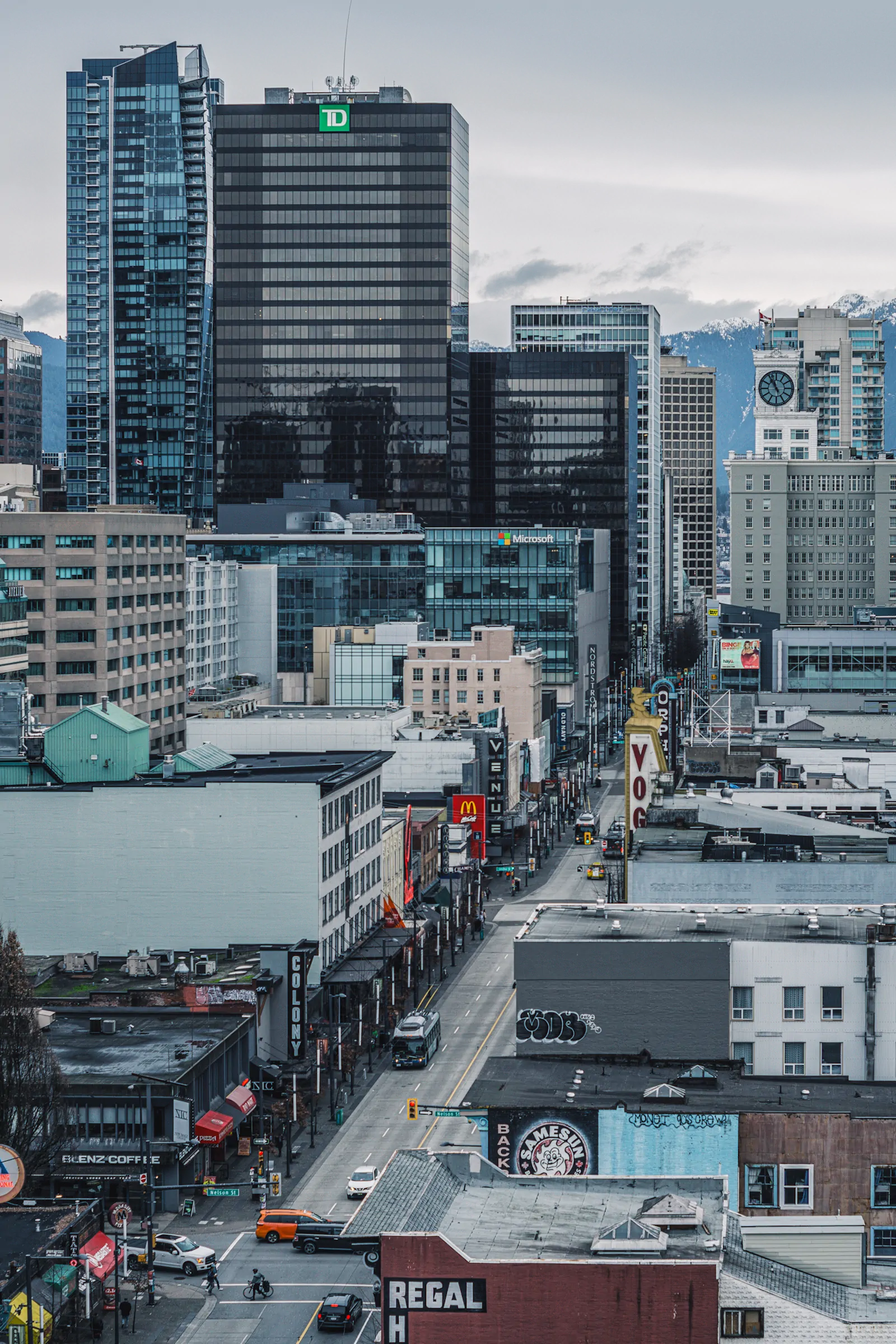
Granville Street Looking North Through Downtown Vancouver
Granville Street looking north through downtown Vancouver, with the Vogue Theatre sign and the Vancouver Block clock tower still doing their old job as landmarks among a much newer wall of glass and office towers. The street below has spent a century being sold, cleaned up, darkened, brightened and redesigned, often in the name of recovering something an earlier redesign helped remove.
Granville's physical peculiarities helped make it good theatre. Its lots are unusually narrow, generally 25 feet rather than Vancouver's more typical 33, producing a tight succession of storefronts and signs competing for attention. By the 1920s the street had become Theatre Row. The Orpheum arrived in 1927, the Commodore at the end of the decade, and the Vogue in 1941. Neon climbed above the façades until Granville acquired names like the "Street of Lights" and the "Great White Way."
Then neon became embarrassing.
By the late 1950s, Vancouver's Technical Planning Board was describing the city's illuminated clutter in terms of "ugliness and disorder." Restrictive sign rules followed, helping dismantle the nocturnal streetscape that had made Granville distinctive in the first place. Decades later, the logic reversed. Vancouver created special Granville Street sign regulations that actively favour neon, animated lettering and large projecting signs because those same things are now considered part of the street's historic character.
The pavement has gone through much the same cycle.
In 1974, Granville between Nelson and Hastings was rebuilt as a pedestrian and transit mall, with widened sidewalks, trees and two lanes largely reserved for buses. The idea followed Vancouver's abandoned freeway plans and a new concern that downtown could not simply keep making room for more cars. Contemporary enthusiasm did not last long. The bibliography of the City's own recent cultural heritage study reads almost like a running argument with the project: stories about falling business, street decay and, by 1981, a Province headline describing Granville Mall as a "people place that discourages people."
Cars were experimentally invited back onto part of the mall in 1987, then removed again when the trial was judged unsuccessful. The street was torn apart once more for Canada Line construction, followed by another major public-realm redesign. By 2025, Vancouver had approved yet another long-range Granville Street plan, this time proposing more pedestrian space, entertainment and conspicuous lighting while explicitly treating neon as something worth preserving and encouraging.
The old ingredients are still visible from up here. The low-rise Theatre Row squeezed between office towers. Vertical signs fighting for space. Buses running where private cars mostly do not. And above Georgia Street, the Vancouver Block's four-faced clock, watching Granville since 1912 and itself illuminated with neon since the late 1920s.
Granville has spent a remarkable amount of time trying to become Granville Street again.
Join the conversation