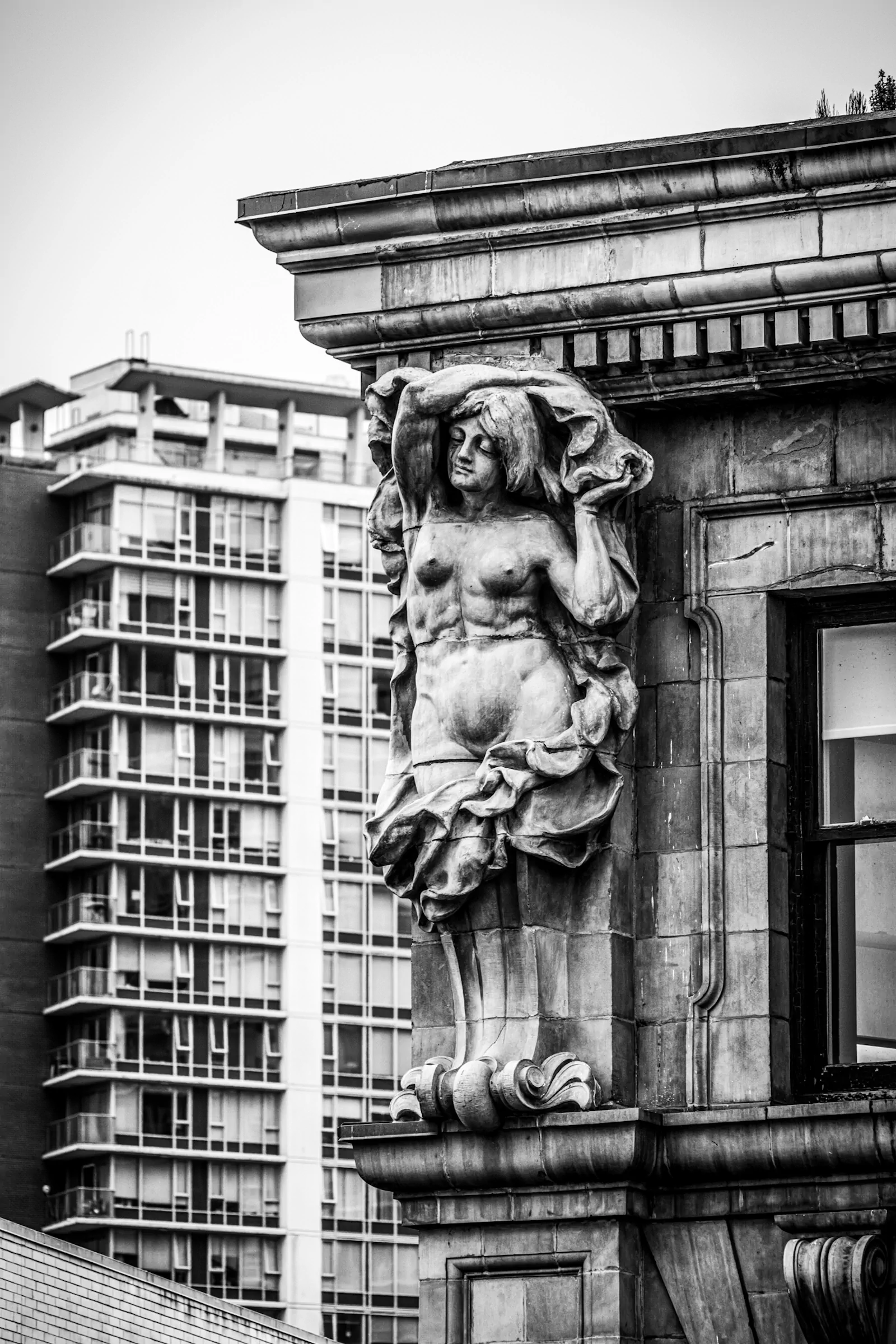
Sun Tower Caryatid by Charles Marega, One of the Nine Maidens
One of the Sun Tower’s Nine Maidens fills the frame here: a terracotta caryatid designed by Vancouver sculptor Charles Marega for the World Building at 128 West Pender Street, completed in 1912. Seen alone, she stops reading as a decorative band and starts looking like somebody under a burden.
Caryatid is the useful word. The figure is not merely attached to the building. Her body has been made into architecture, arms raised into folds of cloth, head and shoulders visually carrying the cornice above. From the street, nine of these women become rhythm. Up close, the repetition disappears and a face emerges.
Marega had arrived in Vancouver only in 1909, after training in Europe and working in South Africa. The World Building commission therefore belongs near the beginning of his Vancouver career, long before the lions at Lions Gate Bridge became his most familiar work.
But Marega did not make these figures alone in some romantic local studio.
The caryatids were supplied in 1911–12 by Gibbs & Canning of Glascote, near Tamworth in Staffordshire. The firm was one of Britain's major architectural terracotta manufacturers, already famous for work on buildings including London's Natural History Museum. Vancouver's new newspaper skyscraper was buying from the same industrial system that shipped elaborate fired-clay architecture around the British Empire.
That makes this woman a fairly international Vancouver citizen. An Italian-born sculptor working on Canada's Pacific coast designed her. An English factory translated the design into architectural terracotta. A ship carried the finished work across an ocean. And she ended up holding the edge of a skyscraper built to advertise the confidence of a newspaper publisher in a city barely twenty-five years old.
Over time, nobody quite agreed on what to call the women. Heritage records use caryatids. Vancouver settled affectionately on Nine Maidens. Popular descriptions often call them muses. Their local fame became substantial enough that an eating place inside the building was eventually called the Nine Maidens.
What nobody seems to have preserved is her own name.
The historical record is excellent at remembering William Tuff Whiteway, Louis D. Taylor, Charles Marega, the steel fabricators, the contractor and even the Staffordshire company that fired the clay. I could find no surviving source identifying a model for this particular figure, assuming there was one.
Perhaps that is what makes the close photograph more interesting than the group.
Elsewhere on the façade they are nine women performing a decorative job. Here there is one tired-looking face, one body converted into a column, and more than a century of rain sitting in the folds. The archive calls her one of the Nine Maidens.
The camera does not have to.
Join the conversation