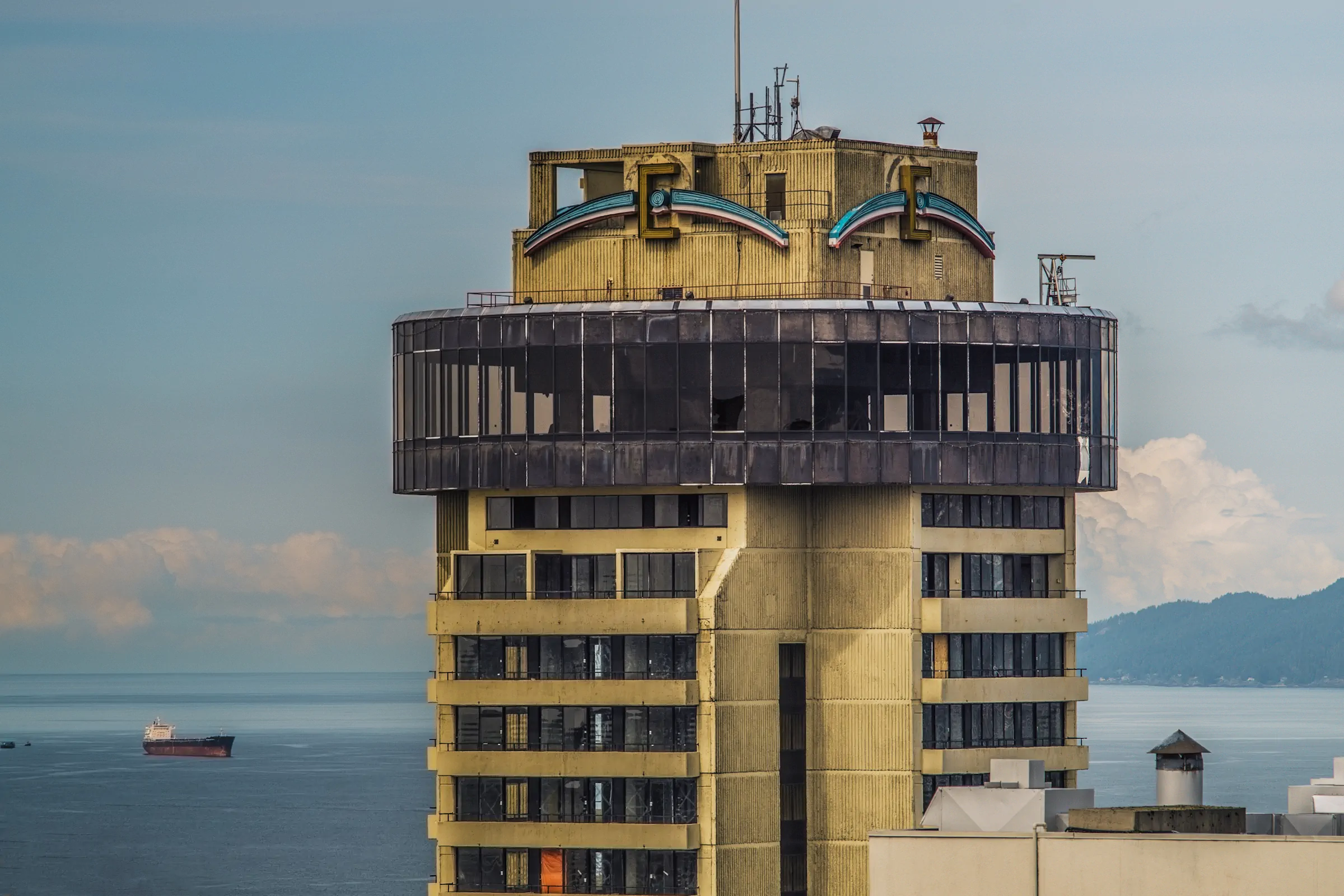
Empire Landmark Hotel and Cloud 9 Before Demolition, Vancouver
Cloud 9 had spent more than forty years making one slow revolution above Robson Street every hour. By April 2018 it had stopped. The Empire Landmark Hotel was closed, demolition had begun, and the dark ring of the 42nd-floor restaurant was already losing its windows.
The tower opened as the Sheraton-Landmark, developed by Vancouver businessman Ben Wosk and designed by Lort & Lort. Its grand opening came on January 18, 1974, later than planned. An elevator strike had left the upper floors inaccessible. For a while the first eight floors operated anyway, with guests expected to get themselves and their luggage upstairs. The completed hotel cost about $12 million and reached roughly 120 metres above the West End.
Cloud 9 was the part people remembered. The outer dining floor turned around the stationary centre so slowly that dinner supplied its own moving panorama of English Bay, Stanley Park, the harbour and downtown. The mechanism responsible for all this metropolitan theatre was wonderfully modest: a quarter-horsepower electric motor.
The newspaper trail around the top of the Sheraton-Landmark is almost a story by itself. In 1972, the Province ran "Tiny motors for big job." As construction neared completion, another headline called it a "Black top on white peak." Then came "Neon lights on hotel protested." The exterior lighting did not comply with the development permit, nearby residents complained, and by January 1974, the Vancouver Sun was reporting that the City had pulled the switch. The sign could stay. The extra illumination could not.
It is easy now to mistake the hotel for a piece of anonymous 1970s concrete that happened to survive longer than expected. At the time, it was an aggressively conspicuous building. It was exceptionally tall for a hotel, unusually narrow for a tower over forty storeys, capped with a moving restaurant, and determined enough to advertise itself after dark that City Hall got involved.
By the time this photograph was taken, the spectacle had become a demolition problem.
Taking down a 42-storey concrete hotel on a busy West End block by conventional means would have been unpleasant for everyone nearby. JMX Contracting instead worked from the top with remote-controlled Brokk demolition machines mounted inside a climbing enclosure. Hydraulic crushers chewed the concrete rather than hammering it apart. Debris was pushed inward and sent down the building through the old elevator shaft. Floor by floor, the tower shortened without an implosion and without dropping its upper storeys into Robson Street.
That process was only just getting underway here. The restaurant had served its last guests on September 30, 2017. Several months later, Cloud 9 was still physically present but already hollowed out enough to see daylight through parts of the enclosure.
The restaurant itself survived atop the shrinking hotel until late 2018. By December, the dark ring in this photograph was gone.
Join the conversation