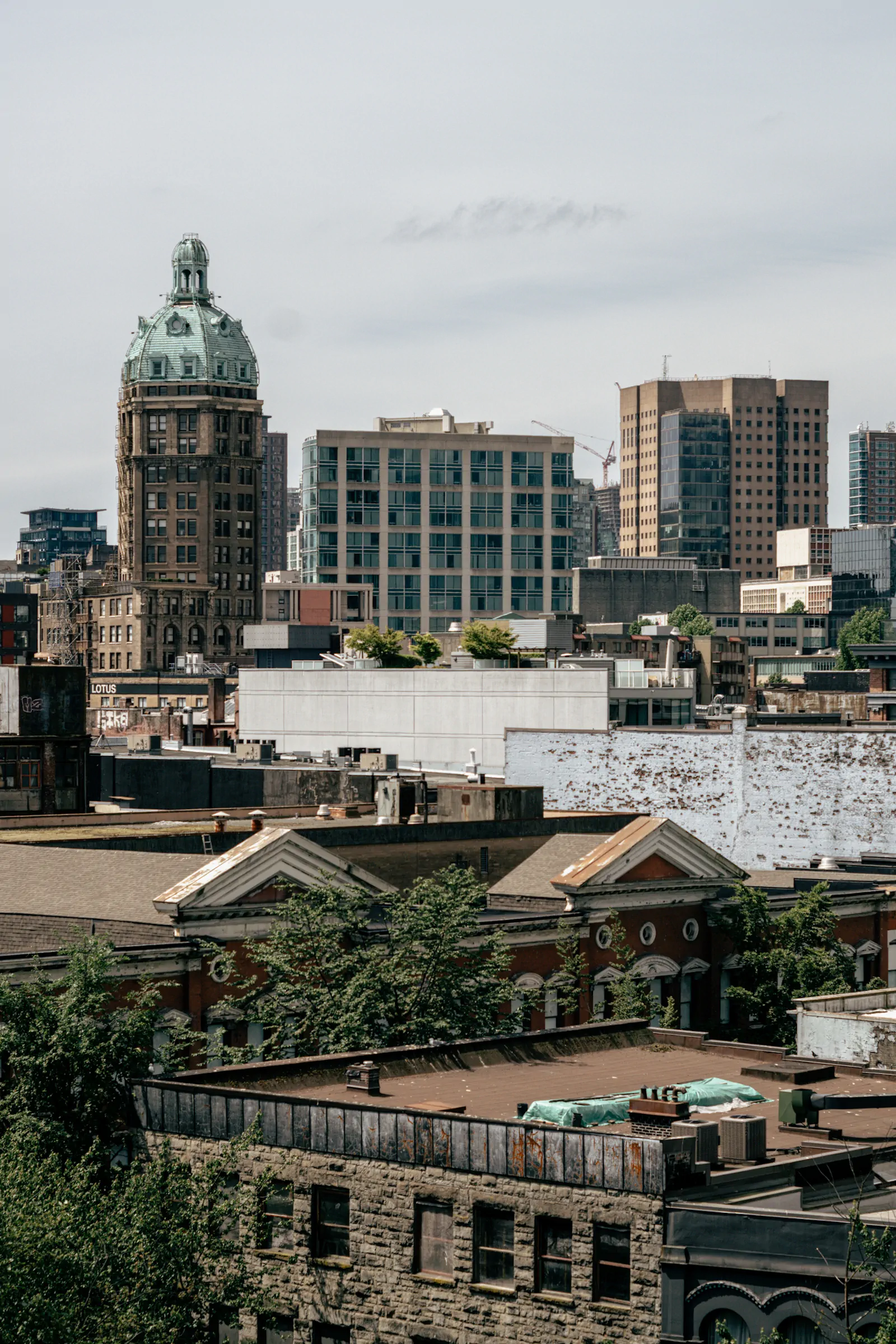
Army & Navy and Sun Tower in Vancouver's Old Commercial Core
Army & Navy at 36 West Cordova Street sits below the Sun Tower in the old commercial heart of Vancouver. When the World Building opened in 1912, this part of Hastings, Pender and Cordova was still crowded with banks, offices, hotels and major retailers. Seven years later, Sam Cohen opened Army & Navy nearby.
The World Building belonged to a moment when eastern downtown still looked like a sensible place to build big. Newspaper publisher and politician L.D. Taylor put the Vancouver World into an extravagant new skyscraper designed by William Tuff Whiteway. Taylor's timing was poor. The real-estate boom broke in 1913, the courthouse had already moved west to Georgia Street, and the city's financial institutions were gradually following.
George Wilby, who had worked at the World, later remembered the project without much romance. The location was wrong, the financing was difficult and, as he told city archivist Major J.S. Matthews, "in the end the mortgages got it."
The tower survived its owner.
Cohen's business grew in a different Vancouver. He opened Army & Navy on West Hastings in 1919 with about $10,000 worth of merchandise purchased from a failed Kamloops retailer. Instead of competing with the grand department stores on presentation, he built the company around bargains: bankrupt inventories, manufacturers' overruns and military surplus.
That model aged remarkably well as the neighbourhood around it lost commercial status.
Army & Navy expanded into the West Cordova buildings in 1948. It did not replace the block with a purpose-built flagship. Existing nineteenth-century commercial buildings were joined together, altered and, in places, substantially rebuilt behind their old facades. The result suited the business. Old architecture carrying whatever the city still had use for.
Hastings Street continued to draw shoppers for decades through Woodward's, Eaton's and Army & Navy, even as offices and institutions concentrated farther west. Pacific Centre strengthened Georgia and Granville after 1970. Eaton's eventually left the eastern downtown. Woodward's closed in 1993.
The older commercial blocks remained.
That survival should not be mistaken for careful preservation from the beginning. By the 1960s, large parts of Gastown and the surrounding district were threatened by freeway and urban-renewal plans. Some buildings had lasted because redevelopment pressure was weak; keeping them standing once that pressure returned required a political fight. Public opposition stopped much of the clearance, and Gastown received provincial historic-area protection in 1971.
By then, the neighbourhood had performed a strange economic trick. Losing the city's most valuable business activity had helped spare buildings that later became valuable precisely because they were old.
Army & Navy closed in 2020, after 101 years in Vancouver.
Join the conversation